PrestaShop · January 2025 – August 2026
Expert portal rebuild: preparing a strategic decision through proof
From a directory repair request to a Build vs Buy vs Optimize decision, settled in front of two prototypes side by side
PrestaShop · January 2025 – August 2026
From a directory repair request to a Build vs Buy vs Optimize decision, settled in front of two prototypes side by side
Capability demonstrated
Preparing a strategic investment decision and carrying it through with tangible proof
Deliberate wireframe · the real screens are shown on request
Context
The PrestaShop Expert program brings together the partner agencies that help merchants build, migrate and maintain their stores. Its portal, built on an off-the-shelf partner relationship management (PRM) tool, was meant to be the program's hub: registration, certifications, leads, public directory and private agency space. After two years of full use, it was holding the program back at the very moment the certification model and the company's data logic were changing in depth.
Problem addressed
The organization had to decide on a structural investment with no usage data to ground the assessment, against its own sunk cost bias, and on the basis of a request (fix the directory) that hid the real question: build a measurable product, or keep paying for the structural ceiling of a tool.
My role
Head of Product Design of a collective effort: framing the design brief, structuring the two successive discoveries, guaranteeing the voice of external and internal users, leading the Build vs Buy vs Optimize process. Neither budget nor final decision, which belonged to the sponsors: the responsibility was the quality of the case brought to the decision.
Approach
Establish the facts before proposing, requalify the repair request into an investment decision, design the target by pairing internal and external journeys, and build the sponsors' conviction along the way rather than in a final meeting.
Key decision
Outcomes
AI involvement
At two levels. For the decision: AI-assisted prototyping (Figma Make, Lovable) produced the two artifacts compared side by side, and making the value gap tangible changed the conversation with the sponsors. For the rebuild: the documentation and the design and front-end evolutions of the portal were driven end to end by directing AI, more than 21,000 AI actions directed over the rebuild window, measured and published in a personal orchestration report.
Evidence
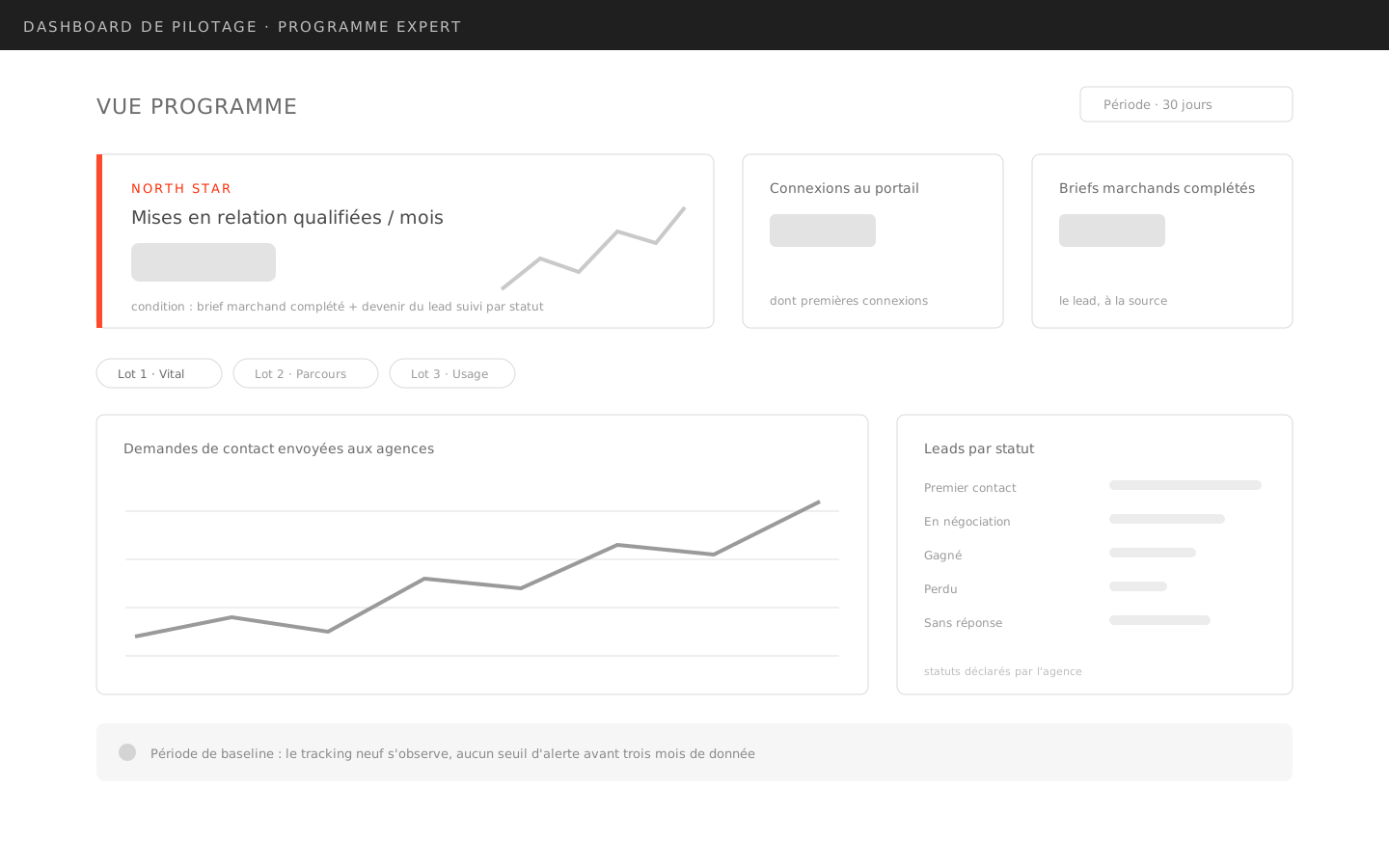

These visuals are deliberate wireframes: the real work lives in playable demos, shown live. Ask to see them .
The partner agencies of the Expert program help PrestaShop merchants build, migrate and maintain their stores. To run this network, the company relied on a portal built on an off-the-shelf PRM tool: agency registration, certification management, lead distribution, a public directory for merchants and a private space for agencies.
Two years after deployment, the tool was used to its full potential by every team: workflows, synchronizations, directory, deal management, scoring. At the same time, the program was changing scale. A new certification model, a rework of the customer data logic, the ambition to turn the ecosystem into a measurable business lever rather than an opaque cost center. The portal was supposed to carry that transformation. It was holding it back.
On the surface, an improvement request: broken filters on the directory, dated pages, frustrated agencies. Underneath, three blockers of a different nature.
The structural ceiling first. Every team was using the tool correctly, and the tool could not do better. A locked front end where every change went through the vendor’s support, one-way CRM synchronization, multilingual content re-entered language by language. A usage gap can be fixed with training. A structural ceiling cannot.
The absence of measurement next. No reliable data on searches, clicks, contact requests. The directory was a black hole: unable to prove its value, unable to prove its failure, so impossible to arbitrate on anything but intuition.
Sunk cost bias last. Years of investment, processes built around the tool, an ongoing contract. Everything pushed the organization toward yet another repair effort, more comfortable to defend than a reassessment.
The situation called for something other than a redesign project: creating the conditions for an investment decision, with no data to ground it and against the organization’s natural slope.
Head of Product Design of the effort, within a collective bringing together product, CRM, marketing, channel, tech and data, carried day to day by a product-design duo.
The mandate: lead the process meant to inform the choice between optimizing the existing tool, buying another market tool, or building. Concretely, frame and write the design brief, structure the two successive discoveries (the public directory, then the portal as a whole), guarantee that every user’s voice weighed in the case, agencies and merchants as well as internal teams, and produce the artifacts on which the decision would be made.
The limits were clear: neither the budget nor the final decision, which belonged to the sponsors. The responsibility was the quality of the case, with a precise expectation: a defensible decision file, within a bounded timeframe.
Establish the facts before proposing. Facing a contested but entrenched tool, the first battle is factual: a dozen agency interviews, six workshops with every team operating the portal, five key journeys replayed step by step, an external audit of the experience and the architecture, a benchmark of the alternatives. This work established the fact that changed everything: the problems did not come from a lack of usage but from the limits of the tool itself. Naming that difference in front of the sponsors was the first deliverable of the effort, before a single screen.
Requalify the request. The directory discovery surfaced two blind spots. No usage measurement anywhere: without data, every improvement discussion was played on intuition. And an SEO cannibalization no one had qualified: the most natural organic search for finding a partner led to another internal directory, the modules one. Fixing filters could do nothing about that. The question was therefore reformulated, and owned as such in the brief: do we want to build a measurable product that creates value for merchants, agencies and the company? Framed that way, it called for a decision, not a facelift.
Design the backstage along with the storefront. The agencies’ frictions (opaque scoring, leads with no follow-up, scattered information) were partly the symptom of an internal problem: the Channel Managers, responsible for agency portfolios, had no consolidated view and pieced reality together from emails and exports. The design brief set the principle: a smooth internal experience is a condition for a successful partner experience. Every agency journey in the target was designed as the mirror of the internal journey that makes it possible.
Build conviction along the way. Leaving a tool involves contracts, migrations and teams: it is not won in a readout meeting. The setup was designed against the tunnel effect: short, regular check-ins with the sponsors, learnings and doubts shared as they came, a discovery board open to everyone. The decision meeting was only ever meant to formalize a conviction already built.
That left the choice of how to bring the final decision. Three options.
A classic comparison file, weighted matrices and scores included. Rigorous, but with no grip on the real adversary: against sunk cost, every number in a table can be argued, and the status quo option always walks out alive.
A user test of the target prototype. Useful to validate an experience, but off topic for the decision: the sponsors’ doubt was not about the desirability of a better portal, it was about the necessity of leaving the tool to get it.
The third option was chosen: put two artifacts side by side. On one side, the prototype of the rebuilt experience, with a trust journey for the merchant, verified proof on agency profiles, a brief form that qualifies the request, a feedback loop that feeds the system. On the other, a simulation of the best the existing tool could do, built honestly, patches and broken journeys included. That honesty was the credibility condition of the case: a caricatured strawman would have destroyed trust.
The validation criterion was written before the presentation: not a score, not a test, but the sponsors’ reaction on seeing the two scenarios side by side. A value gap described in a report gets debated. Made navigable, it gets observed.
AI-assisted prototyping made this choice viable: two comparable, manipulable experiences produced in a few days, where weeks would have been needed. This practice, learned by doing, has since served as a model for other decision cases.
One honest note on tempo, because a story too smooth would serve no one: the case moved faster than its formalization. Collective conviction consolidated artifact after artifact, up to a decision that surprised no one. That was the point of the setup.
The decision first. The organization left repair mode and made a structural choice: leave the market tool at the end of the contract and rebuild. The documented file is its record: diagnosis, options, proof, recommendation.
The capabilities next. The public directory, the most exposed piece, was rebuilt and remains visible online at experts.prestashop.com/fr/agences, measurable by design: tracking plan, SEO and CRM integration specified before the first mockup. The in-house Expert portal followed with a private agency space, developed internally and available behind login from experts.prestashop.com/fr/connexion. Teams now change a partner journey without opening a ticket with a vendor.
The data black hole from the start received a structural answer, delivered with the production release. A North Star first: qualified connections per month, the value of the ecosystem reduced to a single indicator. Then the KPIs that break it down, measurable from V1: portal logins, with first logins isolated to track the post-migration window; completed merchant briefs, which materialize the lead at the source; contact requests sent to agencies; and the fate of each lead, tracked by status from first contact to won or lost. The whole fits in a tracking plan of about thirty events covering eleven business use cases, from agency activation to lead handling, and in a steering dashboard specified batch by batch, from vital to comfort. With an assumed discipline: a baseline period before any alert threshold, because fresh tracking is not interpreted, it is observed. The program that could prove nothing now knows exactly what it has to measure.
The first launch signals mostly confirm the change of regime. Over the June 1 to July 31, 2026 window, the portal made visible 247 connected partners, 139 new accounts, about 36 unique merchants for 87 raw briefs, 70 certifications purchased, 211 active subscriptions and 417 verified stores. Perfect Match becomes possible in that context: not as a feature placed next to the directory, but as the natural extension of a portal that finally structures merchant needs and agency data.
The practice itself, finally, and it is measured. The portal rebuild was the opportunity to transform the way of designing: documentation and the design and front-end evolutions driven end to end by directing AI rather than coding in its place. The orchestration report kept over the rebuild window gives the measure: 21,458 AI actions directed, spread across five verbs, explore, act, structure, document, delegate. The split tells the posture: execution is massively delegated to AI, structure and documentation stay human, so the product remains steerable once you are no longer in the loop. And the tool changed along the way, from one coding agent to another, without changing the method: the direction does not depend on the tool.
Part of that practice was later formalized as the Playground-driven design method: specifying sections and their states in code before the API hookup, to reduce the translation between design and development.
The operating model of the small squad is detailed in the case study Expert Portal: replacing a tool with a squad of three.
The organization, finally. The Build vs Buy vs Optimize framework serves as a reference for the other pieces of the ecosystem. The mirrored-journeys principle, external and internal designed together, applies to the following efforts. And preparing decisions with compared prototypes has become a practice that outgrows this case.
The next effort is open: turning the directory, now instrumented, into an engine of qualified connections between merchants and agencies. The value of an ecosystem is not measured by the profiles it displays, but by the connections it creates.
The mandate ended in August 2026, and the effort was handed over equipped to continue without me: the portal in production, the North Star and its measurement plan, the specified dashboard, the decision log. That was the design criterion from day one, and it is the real test of everything above.
Takeaway
Sunk cost bias does not yield to arguments: it yields to tangible proof, placed side by side, honest even in the scenario that hurts. The role of design, at this level of responsibility, is not to produce screens: it is to make the value gaps so visible that the decision becomes an observation. And that decision is not played out on the day of the meeting: it is built along the way, shared doubts included. The meeting only formalizes it.
Last updated ·
Written with terquedad colombiana, in the south of France.
Not with love, with context and a patient agent.
Still learning.
© 2026 All rights reserved.